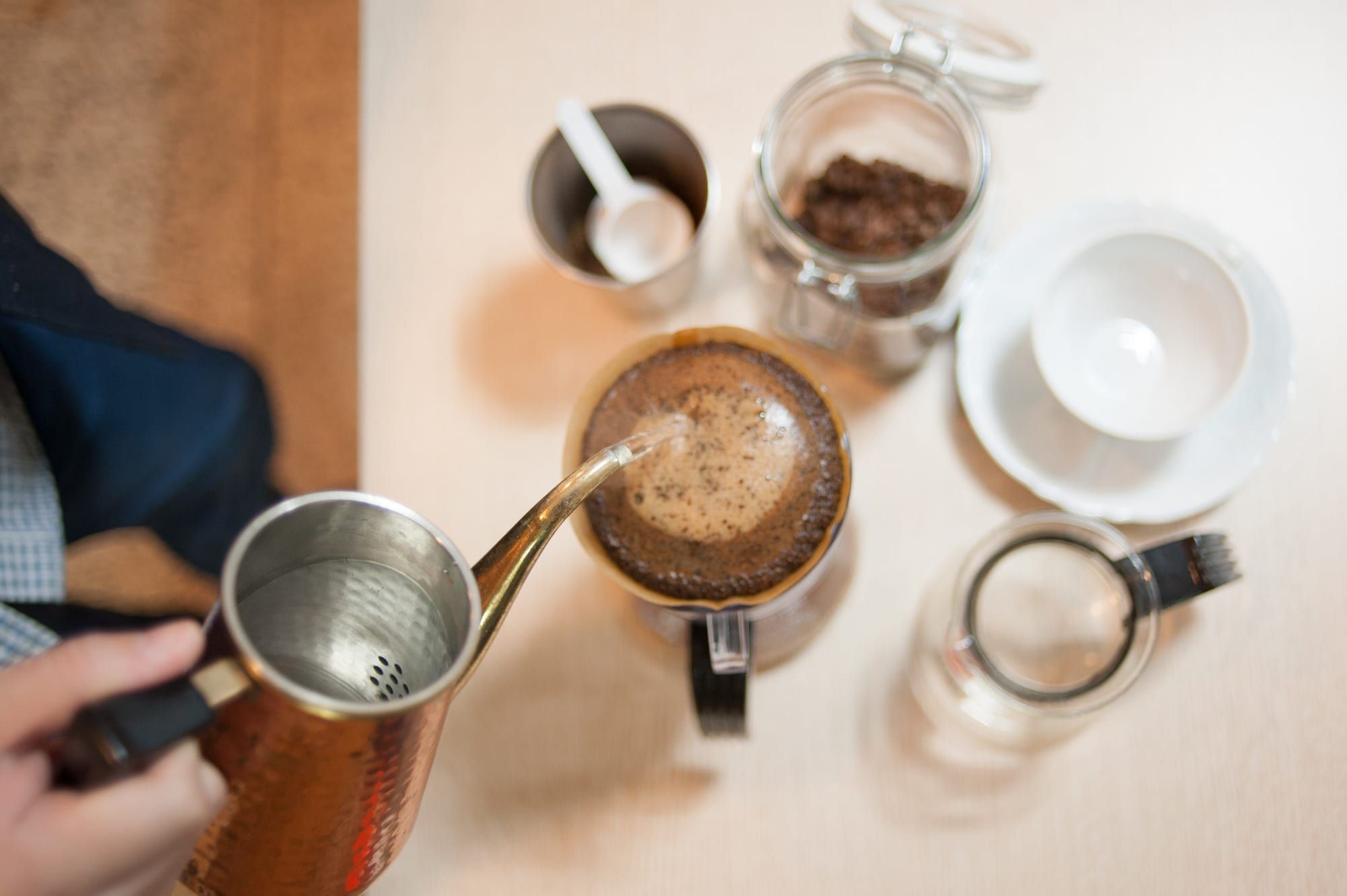
Pour-over coffee is the simplest way to brew a clean, flavourful cup: you pour hot water over ground coffee held in a paper filter, and gravity does the rest. All you need is a dripper such as the Hario V60 or the Chemex, a burr grinder, a kettle, a scale and fresh beans. A good starting recipe is about 15 grams of coffee to 240 grams of water, with water just off the boil, over about three minutes.
This guide explains how pour-over works, which equipment makes the biggest difference and a method you can repeat. It also covers how to fix common problems.
What is pour-over coffee?
Pour-over, also called filter or drip coffee made by hand, is a brewing method in which hot water flows through a bed of ground coffee and a paper filter into a cup or server. Unlike immersion methods such as a French press, the water keeps moving, so flavours extract steadily and the paper filter keeps oils and fine particles out of the cup.
The method rewards control. By changing the grind size, the water temperature and the pouring speed, you change how much flavour comes out of the coffee. Because the variables are visible and adjustable, many coffee enthusiasts prefer it.
What equipment do you need?
| Item | Why it matters | Example |
|---|---|---|
| Dripper | Shapes the flow and extraction | Hario V60 or Chemex |
| Paper filters | Remove oils and fines | Sized to the dripper |
| Burr grinder | Even particle size | TIMEMORE Chestnut C3s |
| Kettle | Controls temperature and pour | Fellow Stagg EKG |
| Scale with timer | Repeatable recipes | TIMEMORE Basic 3.0 |
| Mug or server | Collects the coffee | Any |
The dripper
The Hario V60 Glass Coffee Dripper 02 is a conical dripper with spiral ridges. Hario describes its conical shape as allowing deeper layering of grounds, and its ridges and unrestricted flow let you change the body of the cup by pouring quickly or slowly. The 02 size brews one to four cups, is made from heatproof borosilicate glass in Japan and costs $25.
Hario V60 Glass Coffee Dripper 02
A conical heatproof-glass pour-over dripper with spiral ridges, sized for one to four cups.
$25 (October 2026, US list price)
The CHEMEX Six Cup Classic is a different approach: an hourglass glass vessel with a wooden collar that combines dripper and server, used with CHEMEX bonded paper filters. It is a good choice if you make coffee for two or more. It costs $49.50.
CHEMEX Six Cup Classic
The classic hourglass glass pour-over brewer with a wooden collar, used with CHEMEX bonded paper filters.
$49.50 (October 2026, US list price)
The grinder
Grind quality matters more than any other piece of equipment. A burr grinder produces even particles; a blade grinder does not. The TIMEMORE Chestnut C3s is an affordable hand grinder with 38 mm stainless steel burrs, an all-metal body and 0 to 90 clicks of adjustment, priced at $89. It grinds up to 30 g at a time, which is plenty for one or two cups.
TIMEMORE Chestnut C3s Manual Grinder
A compact manual burr grinder with an all-metal unibody and 38 mm stainless steel burrs that grinds up to 30 g.
$89 (October 2026, US list price)
The kettle
A gooseneck kettle has a narrow spout that gives you a slow, controlled stream. The Fellow Stagg EKG Electric Kettle adds variable temperature control and 1200 watts for quick heating, and its Pro variants are listed at $199.95. It is a luxury, but it makes the pour easy to repeat.
Fellow Stagg EKG Electric Kettle
A gooseneck electric kettle with variable temperature control and 1200 watts of power for pour-over brewing.
Pro variants $199.95 (October 2026, US list price)
The scale
A scale with a timer lets you measure the coffee and the water and keep time. The TIMEMORE Basic 3.0 Electronic Espresso Scale with Timer costs $59 in black.
TIMEMORE Basic 3.0 Electronic Espresso Scale with Timer
A compact coffee scale with a built-in timer for weighing beans and water.
$59 in black, $65 in white (October 2026, US list price)
What is the basic method?
Here is a repeatable recipe for a single cup with a V60-style dripper.
- Measure. Weigh 15 g of whole beans. Weigh 240 g of water in your kettle, plus a little extra for rinsing.
- Heat the water to around 195 to 205 F (90 to 96 C). If you do not have a temperature-controlled kettle, bring it to a boil and let it rest for 30 seconds or so.
- Grind to medium-fine, like coarse sand.
- Rinse the filter. Place the filter in the dripper, pour hot water through it to remove paper taste and warm the vessel, then discard the water.
- Add coffee. Pour the grounds into the filter and shake gently to level the bed. Place the dripper on the scale and tare it.
- Bloom. Start the timer and pour about twice the weight of the coffee (about 30 g) over the grounds, wetting them all. Wait 30 to 45 seconds. The coffee will bubble as it releases gas.
- Pour. Pour in slow circles to about 100 g, then to 170 g, then to 240 g by around the 1:30 to 2:00 mark. Keep the water level steady and avoid pouring directly on the filter edge.
- Wait. Let the water drain. A total brew time of about 2:30 to 3:30 is a good target.
- Taste and adjust. Remove the dripper and swirl the coffee.
Tip
Change only one variable at a time. If you alter the grind, the ratio and the water temperature together, you will never know which one fixed the cup.
What ratio should you use?
The ratio of coffee to water determines strength. A common starting point is 1 gram of coffee to 16 grams of water. Some people prefer 1:15 for a stronger cup or 1:17 for a lighter one.
| Ratio | Coffee | Water | Result |
|---|---|---|---|
| 1:15 | 16 g | 240 g | Stronger, richer |
| 1:16 | 15 g | 240 g | Balanced starting point |
| 1:17 | 14 g | 240 g | Lighter, more delicate |
How do you fix common problems?
| Problem | Likely cause | Fix |
|---|---|---|
| Sour, thin, salty | Under-extracted | Grind finer, use hotter water, pour more slowly |
| Bitter, harsh, dry | Over-extracted | Grind coarser, use slightly cooler water, shorten the brew |
| Weak | Too little coffee or too coarse | Use more coffee or grind finer |
| Brew drains too fast | Grind too coarse | Grind finer |
| Brew drains too slowly | Grind too fine or filter clogged | Grind coarser, pour more gently |
| Uneven flavour | Uneven wetting of grounds | Pour in controlled circles, stir the bloom |
Why do beans and water matter?
Beans
Fresh beans make the biggest difference to flavour. Look for a roast date on the bag and use the coffee within a few weeks of roasting. Store beans in an airtight container away from heat, light and moisture, and grind only what you need just before brewing. Lighter roasts usually suit pour-over, because the method highlights acidity and aroma, but any roast works if you adjust the grind and temperature.
Water
Coffee is mostly water, so water quality shapes the cup. Very hard water can leave scale and mute flavour, while very soft or distilled water can taste flat. Filtered tap water is a good, simple choice. If your water tastes bad on its own, it will taste bad in coffee.
How should you pour?
Technique is about keeping the extraction even. Three habits help:
- Pour gently. Aim the stream at the centre and spiral outward, without hitting the filter wall, which lets water bypass the coffee.
- Keep the bed level. If the grounds climb the sides of the cone, a quick swirl at the end flattens the bed so it drains evenly.
- Pour in stages or in one go. Multiple smaller pours give more control, while one slow pour is simpler. Choose one and keep it consistent while you learn.
A gooseneck kettle makes all three easier. With a standard kettle, pour slowly and lean the spout close to the coffee.
What does a first-time shopping list look like?
| Budget | What to buy | Approximate cost |
|---|---|---|
| Lean start | V60 glass dripper, filters, a basic kitchen scale and a hand grinder | $25 dripper, $59 scale and $89 grinder at the list prices above, plus filters |
| Better pouring | Add a gooseneck kettle | Stagg EKG Pro variants at $199.95, or any gooseneck kettle |
| Brew for friends | Swap or add a CHEMEX | $49.50 for the six-cup |
You can begin with a plain kettle and a scale that you already own, and upgrade as you go. The grinder is the part not to skimp on.
How do you keep your gear in good shape?
- Rinse the dripper after every brew. Coffee oils turn rancid.
- Wash glass gently. Glass drippers and carafes can chip or crack if they are knocked or heated and cooled suddenly.
- Clean the grinder regularly. Brush out old grounds and keep burrs dry.
- Descale the kettle following the maker’s directions, especially in hard-water areas.
- Compost the filter and grounds if you can.
Caution
Pour-over uses water at near-boiling temperatures. Pour away from your body, hold the dripper steady and keep the kettle handle clear of your hand.
V60 or Chemex?
| Point | Hario V60 | CHEMEX |
|---|---|---|
| Serves | 1 to 4 cups for the 02 size | Six-cup size for two or more |
| Filter | Thin cone filters | Thick bonded filters |
| Cup character | More body and variation with technique | Very clean |
| Material | Heatproof glass | Glass with a wooden collar |
| Cleaning | Quick | Needs a gentle brush or care |
| Price | $25 | $49.50 |
Both make excellent coffee. The V60 rewards technique and is the cheaper way to start. The Chemex is forgiving and suits sharing.
What this means for you
You do not need to spend much to start. A $25 dripper, a $59 scale and a decent burr grinder will get you most of the way, and a gooseneck kettle can come later. Use fresh beans, weigh everything and change one thing at a time. After a few weeks you will learn how grind size, temperature and pouring change the taste, and you will be able to brew the cup you like.